This week I have spent a lot of time working on my front cover design and developing my ideas. I felt like this was necessary because I wasn’t happy with any of the front cover designs I did previously. The front cover is the first thing people are going to see and will likely determine whether or not someone decides to read and buy a publication, so it is essential that I take my time with it and create a design that will grab people’s attention.
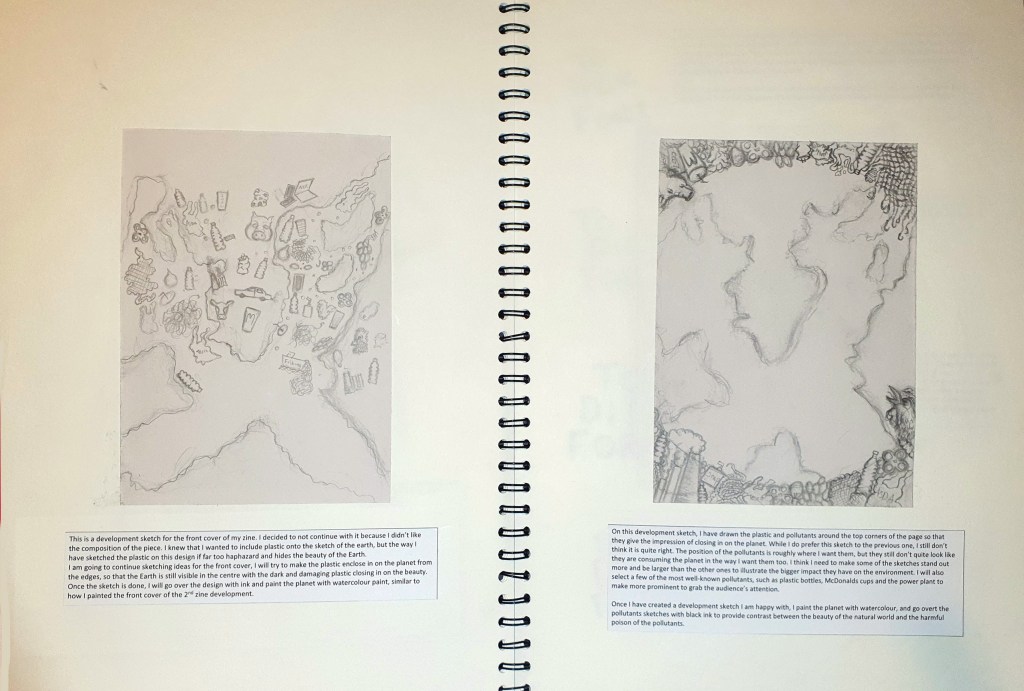
I started this week by sketching out a few ideas I had of how I could show the damaging affect plastic and pollution has on the Earth. I decided that the best way to do this would be to show plastic and pollutants consuming the wonders of the world. My first sketch shows plastic bottles, bags and meat covering the entirety of the Earth in an absolute mess. The composition of this sketch wasn’t very good, it was far too haphazard and covered too much of the planet so I decided to not pursue this design. My 2nd sketch was a lot better than the first, I positioned the plastic and pollutants to the top and bottom of the page to create a border that encloses on the Earth. My idea behind this was to give the impression that the pollutants are attacking the world. I still thought that the composition could do with some improvements though, it didn’t look enough like the pollutants were attacking the planet, but rather falling on it.

My 3rd attempt at creating the front cover went a lot better than the first, I used a 2b pencil to sketch out the design before painting the Earth with watercolour paints. Once the Earth was painted I used biro pen to draw the pollutants enclosing around the Earth, I tried to make them look like fangs to symbolise the negative effect overconsumption has on the planet. I was really happy with this design and I’m confident that it is the one that I am going to take forward and use as my final front cover.
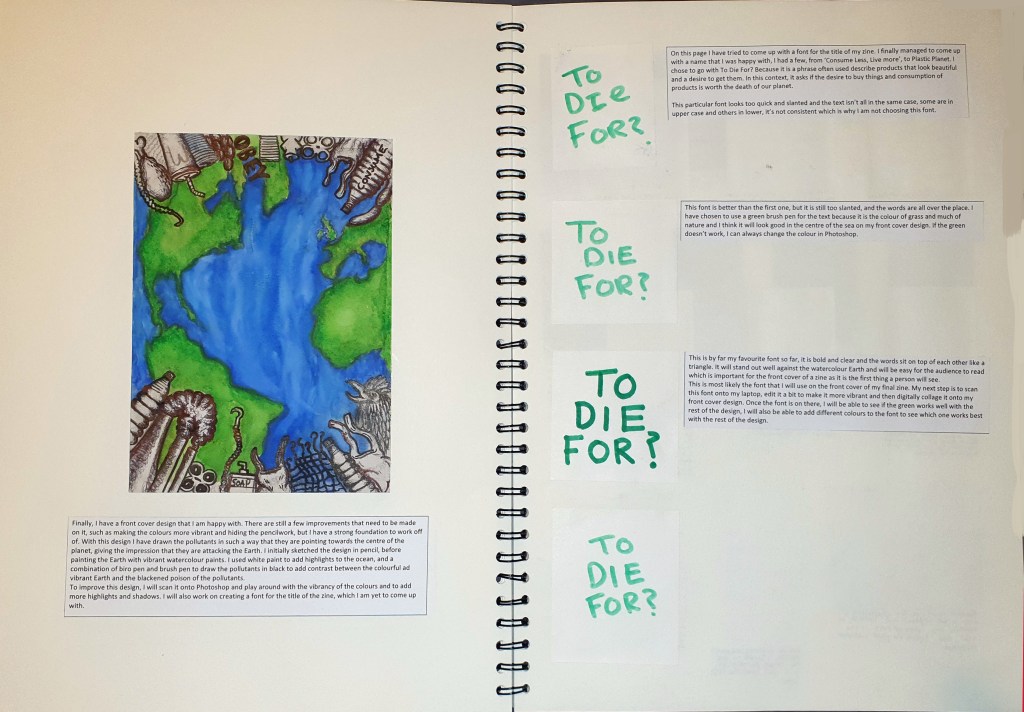
An important part of any front cover and publication is the title, which is something I didn’t have. What I did have though is a few ideas, from Plastic Planet to Consume Your Doom, but I ended up going for To Die For? I chose this because is a term often used to describe a strong desire for something. In this sense, it asks if all of the consuming is worth the plant dying. I tried writing out my chosen title in a few different fonts which I have displayed on the above pages. On the pages below, I have chosen to display the process I used to digitally put my front cover together.

Admittedly, I am still having a hard time motivating myself during the course of this project due to the fact that I’m working at home. I am slowly slipping behind my initial time plan week by week, I should really have finished at least one of my final designs by now, if not more. I am worried that I will have to alter the plans I set out in my proposal and treatment if the deadline isn’t extended or something because of the coronavirus crisis. I just don’t have the space to work effectively like I did when I had access to college facilities, nor do I have access to certain materials and devices that would benefit me greatly, such as an A3 scanner, riso graph machine and printing facilities. I am doing my best to achieve what I set out to do at the start of this project, it is just going slower than I’d hoped it would.
A Few Ways I’m Developing My Zine, and Other Things I’ve Done This Week

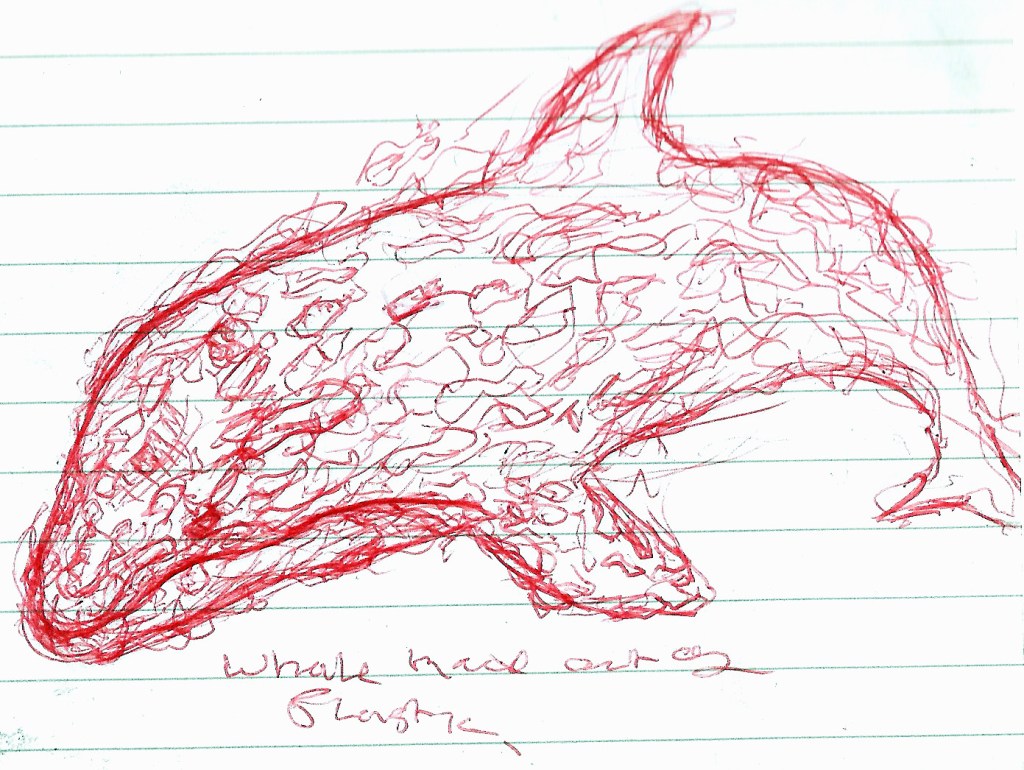
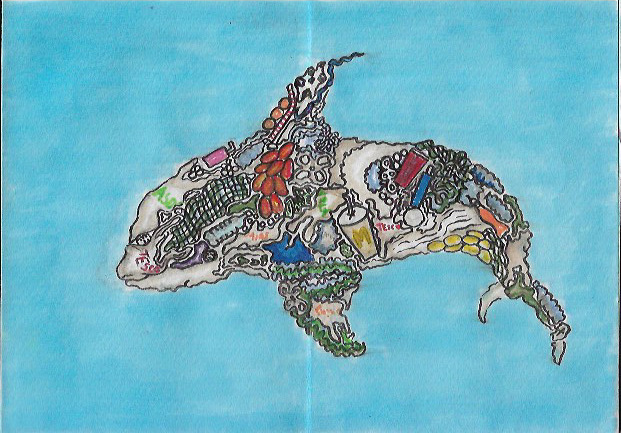
Plastic Orca, Marker Pen on Paper

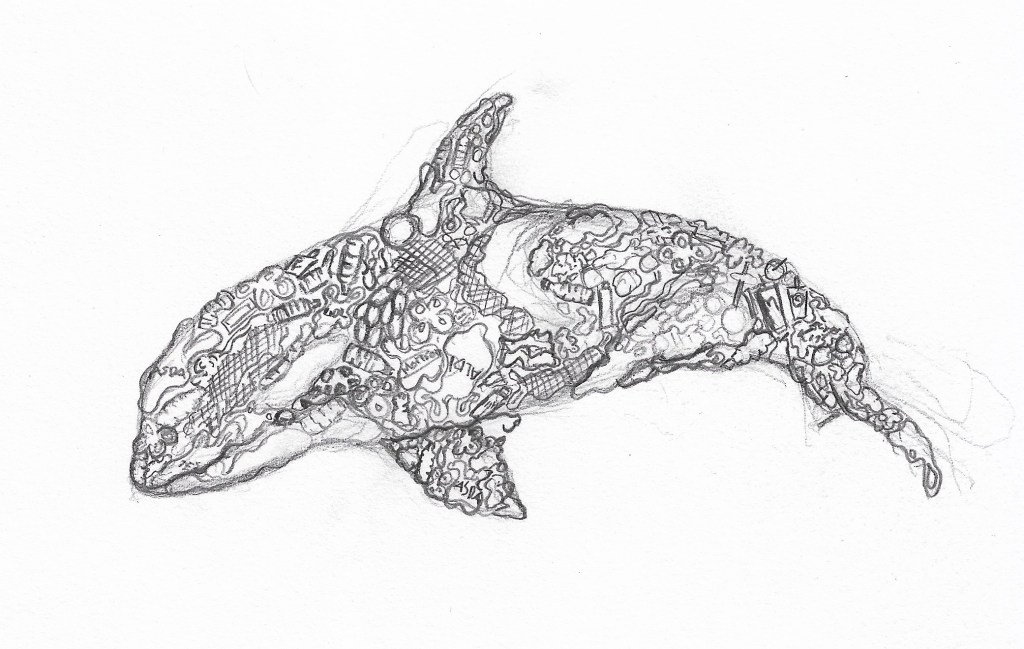
Zine week, it’s one page zine week. I am slowly getting used to the new lockdown way of life, it’s a weird world we’re living in now. I have found that focusing on one thing at a time is the way to motivate myself to do more work. This week has been spent creating a couple of one page zines which have allowed me to experiment with different mediums such as watercolour paint and marker pens. I’m still torn between the two mediums and I can’t decide which one would be best for creating my final zine. They both work well in their own way and neither of them really work for all 3 of the illustrations. For example, the plastic orca illustration seems to look best in brush pen, especially when it comes to creating a simple ocean background; but the advertisement anxiety illustration looks best with a combination of biro pen and watercolour paint. I’m starting to think that using mixed media would be the best way to proceed with the project. The one page zine format has also given me an opportunity to do some layout development at the same time as my media testing. It’s such a useful and economic way to work because if, when all of this is over, I want to print the zines, I’ll only have to pay for one page of printing which would save me a lot of money compared to printing other zine formats.

I am going to be making the zine accessible in a digital format as this is the only way I am going to be able to publish my zine due to the lack of printing facilities. I will be able to split the pages of my one page zine digitally using Photoshop or InDesign if I choose to use the one page format for my final piece. Which I might not, because while there are many positives to the format, there are also some negatives, such as the fact it would limit me to a certain number of pages, and the illustrations would have to be rather small as I only have access to A3 paper, meaning each individual page would be reduced to A6. Ideally I would like to draw them each at a minimum of A5.

I really need to spend more time working on layout development too, because so far I have only tried creating double paged spreads with a front and back cover. While I do like these layouts, they are missing a few things such as text and I don’t want to just stick to the first layout idea I’ve had. I should experiment a bit more before deciding which layout will be best for my final zine. I’ve had some more ideas of how I could show conscious consumption since the start of the project too so I intend to create at least one more illustration which I would like to go in the zine, this is naturally going to change my layout ideas. I’m also thinking about adding a contents page, which are present in many zines and magazines, it would make the zine look a bit more professional. The addition of these extra pages would mean that I’d need to explore new methods of creating a zine because the one-page zine format just wouldn’t be viable anymore.

Coming to Terms With Life in Lockdown- Final Project Week 3

This has been a more productive week than last week, I have managed to develop my initial sketches further into more detailed illustrations. I am not completely happy with all of them because they are still a bit all over the place and are nowhere near good enough to go into the zine, but they are an improvement on my initial designs.

I’m still behind schedule on my weekly planner, which I guess is to be expected considering the state of the world right now. Though technically I have more time now, I’m still finding it difficult to motivate myself at home. I was hoping that by now I would have adjusted to the situation, but I haven’t, I miss being able to leave the house and going into college to knock out tons of work in a day. I miss seeing my tutors and the few people I talk to in college, I’m realising how helpful it was to be around a bunch of creatives that are all working, it definitely motivates me. Nevertheless, I am doing my best at home, I’m trying to work consistently, even if my work hours have changed. And while I may not feel like I’m doing as much work as usual, I am still working hard and not giving up. I also have my girlfriend and aunt to talk to and throw ideas off of which I am grateful for, life would have been much harder if I was still in London right now.

Plastic Orca Development Sketch

I am most happy with my orca development illustration which looks most like I see it in my mind. So far, I have only used pencils to create my illustrations, I intend to spend the next week or two working on media testing and layout ideas. I am going to experiment with watercolours, brush pens, digital painting and collage, with the possibility of trying out soft pastels again. I will only try soft pastels if I am able to get access to some, which so far is proving difficult due to shops being closed, I already have the rest of the materials to hand in my home.

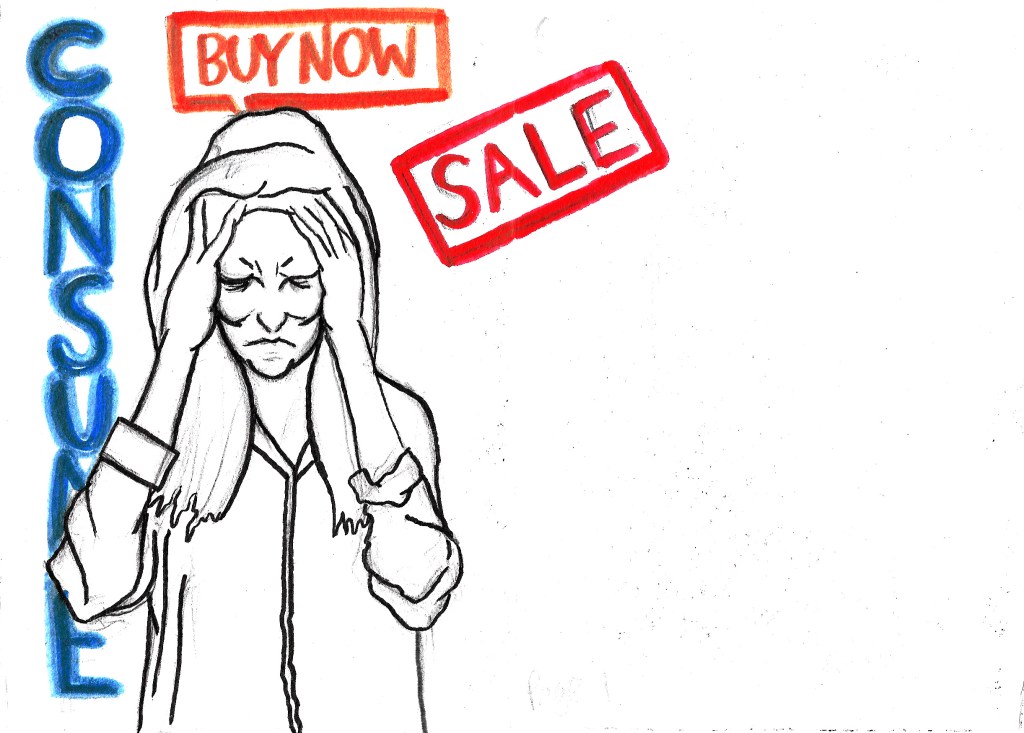
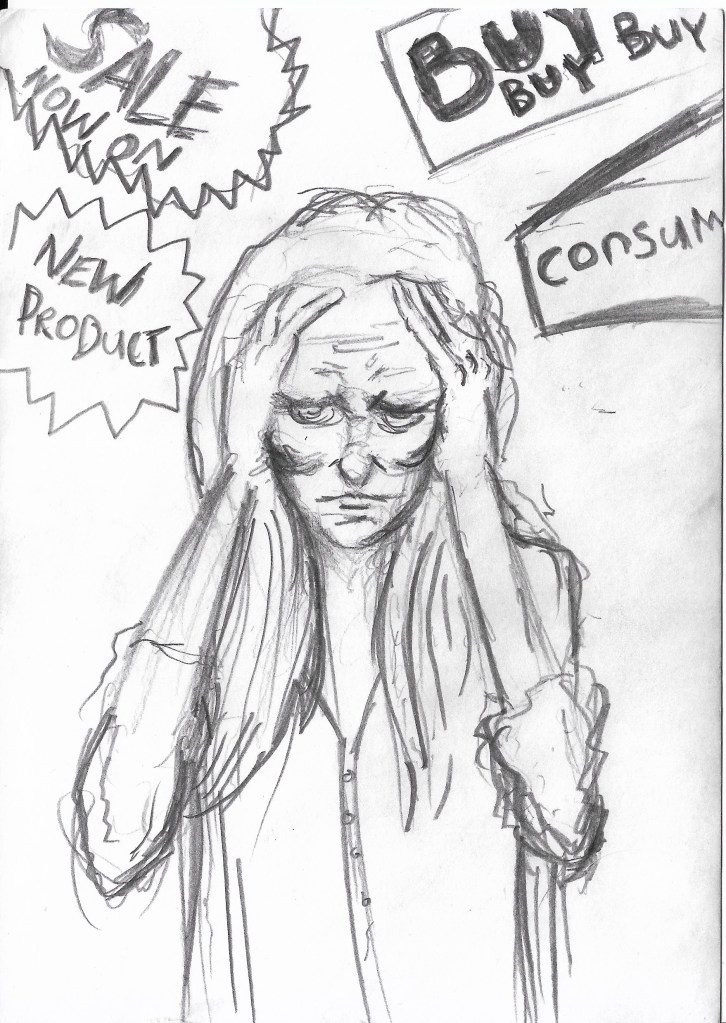
I am also quite happy with my advertisement anxiety development illustration, there is a lot of energy emanating off of it and it’s overtly dramatic, in a good way. There is still a lot of room for improvement with it however, the drawing is still very sketchy and the proportions of the women needs to be improved. I’m still not the most comfortable with drawing people, which is exactly why I need to draw them more, practice makes perfect and all that jazz. I know I’m going to need to draw people if I want to become an editorial illustrator so I’m using the time I have now to get better at them.

Advertisement Anxiety Development Sketch

Speaking of time, if this lockdown situation is still happening over the summer after I have handed in my final project then I am planning on using the time to create a spreadsheet of art directors’ details that I am interested in working for. As well as this, I will also create a series of illustrations that are tailored to publications such as Little White Lies, New Scientist and the Guardian, in the hope that I get onto their radars and get the opportunity to illustrate for them. It would be a great way to get myself out into the world and get some cliental. At the very least, the illustrations would be great for my portfolio, even if they don’t get me work with the companies.

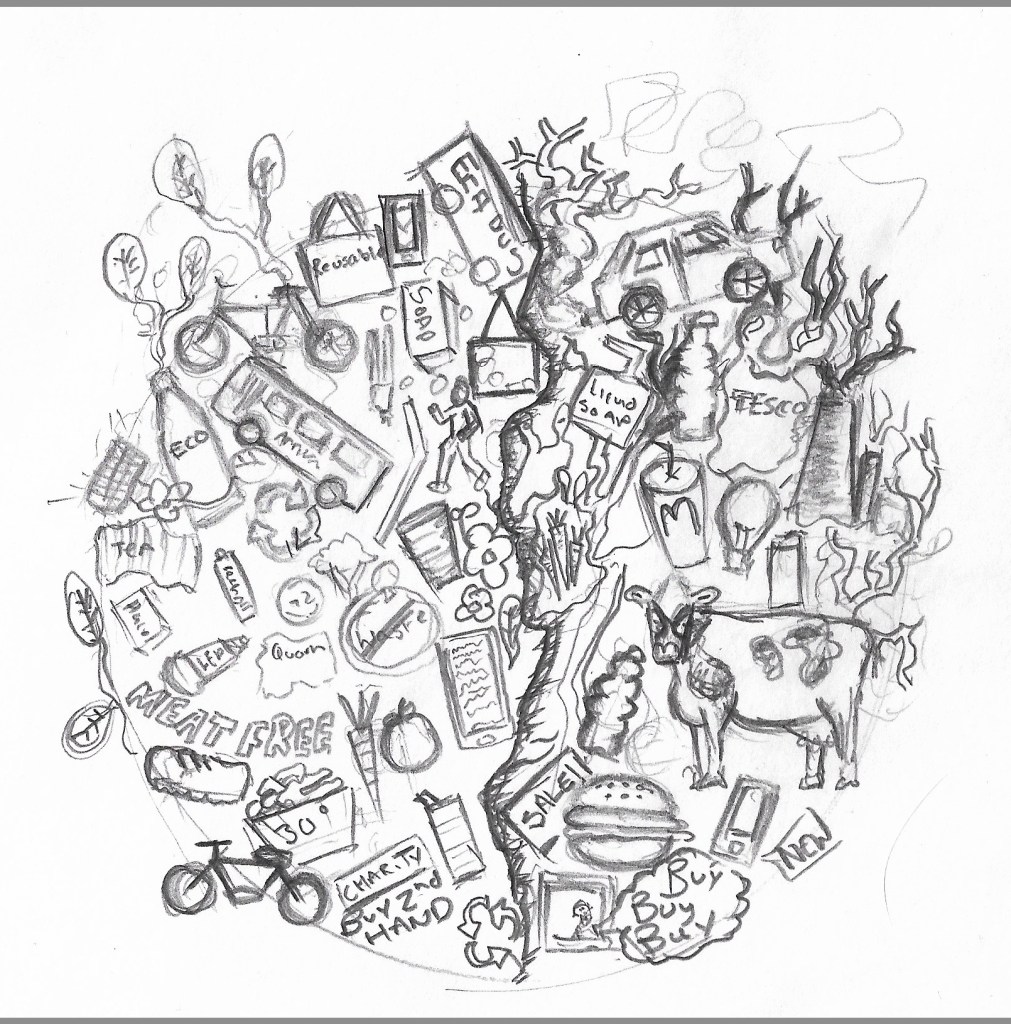
Planet Consumption Development Sketch

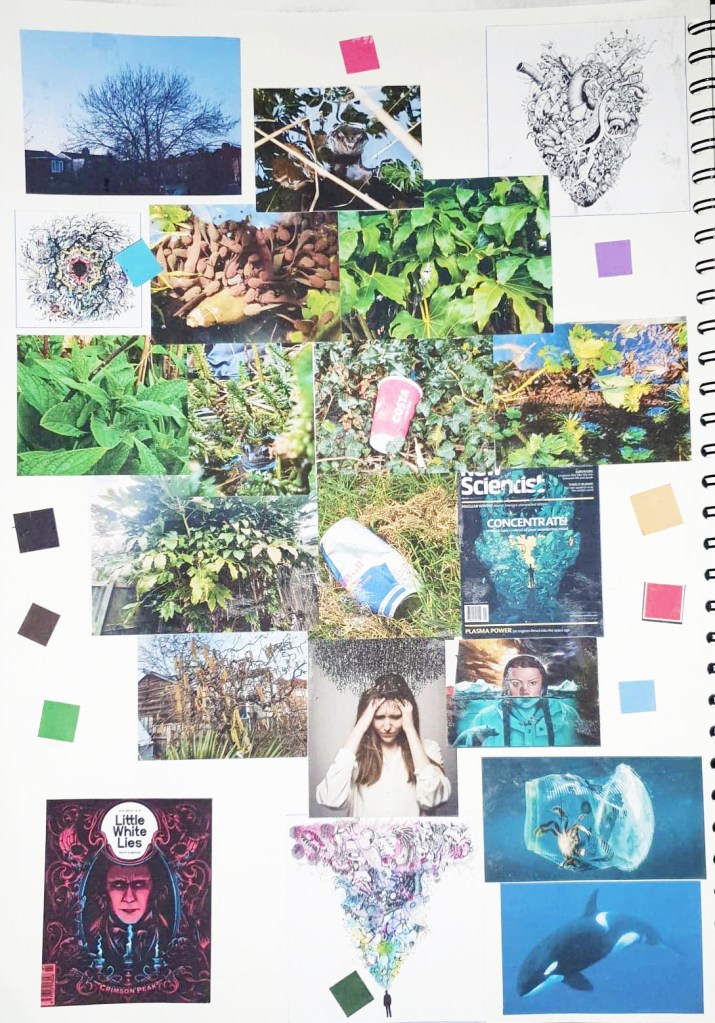
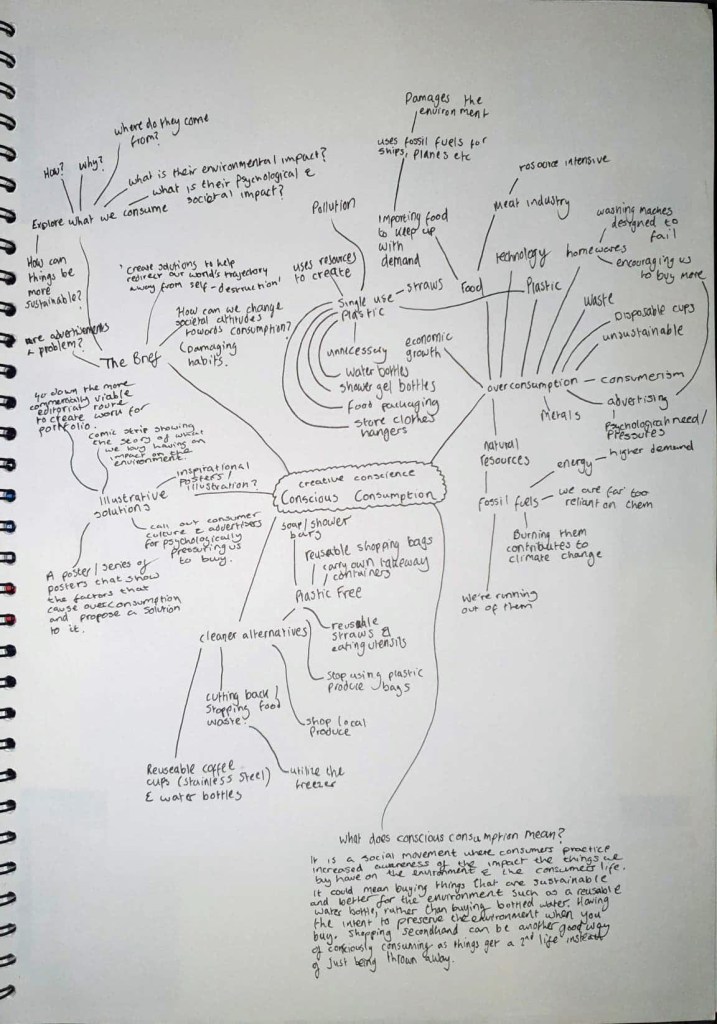
I started struggling with coming up with ideas for how to develop my designs further, and what colours to use on them. It is because of this that I decided to do something that I should have done much earlier in the project, I created a mind map that gathers a bunch of imagery and colour swatches on one page to help me get inspired during the remainder of the project.

What is Life? Working under Lockdown, Final project Week 2

Week 2 of doing project work at home, I have found that my time management is a lot worse now, despite the fact I created a timetable prior to starting the project that essentially mapped out the following 8 weeks. I guess it is just going to take time to adjust to life in lockdown. This experience will also benefit me in life after college as I won’t have a separate building to go to, I’ll most likely be working from home then, as I am now so this will prepare me for that.

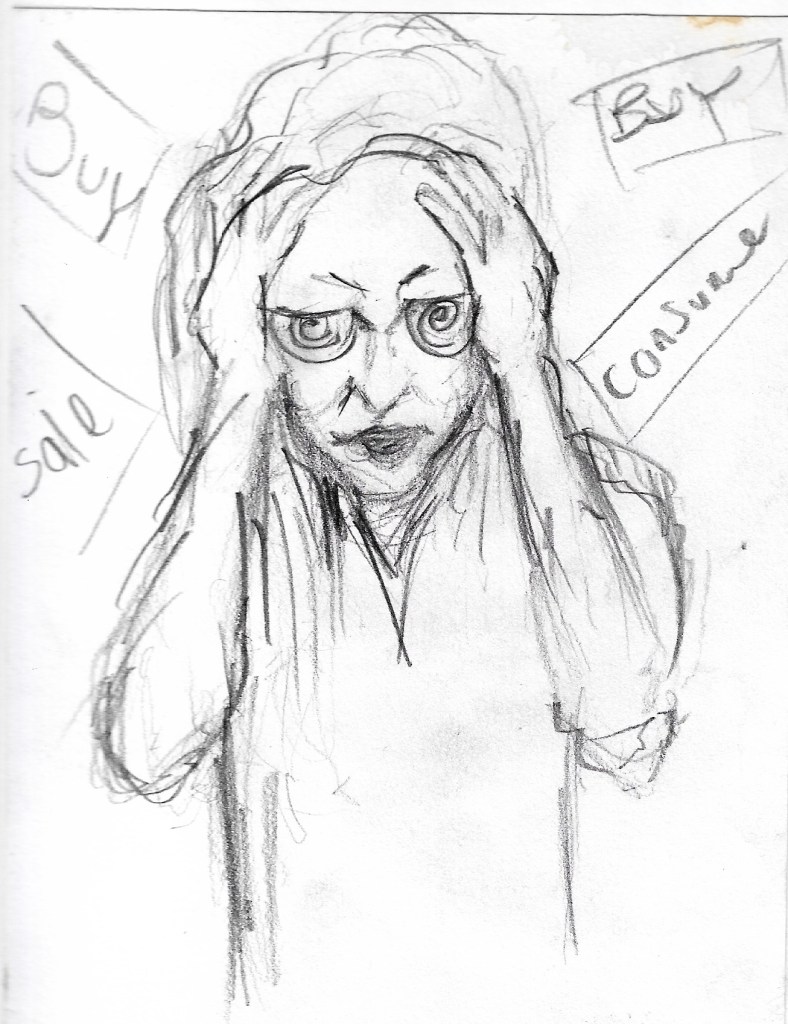
Advertisement Anxiety Initial Sketch

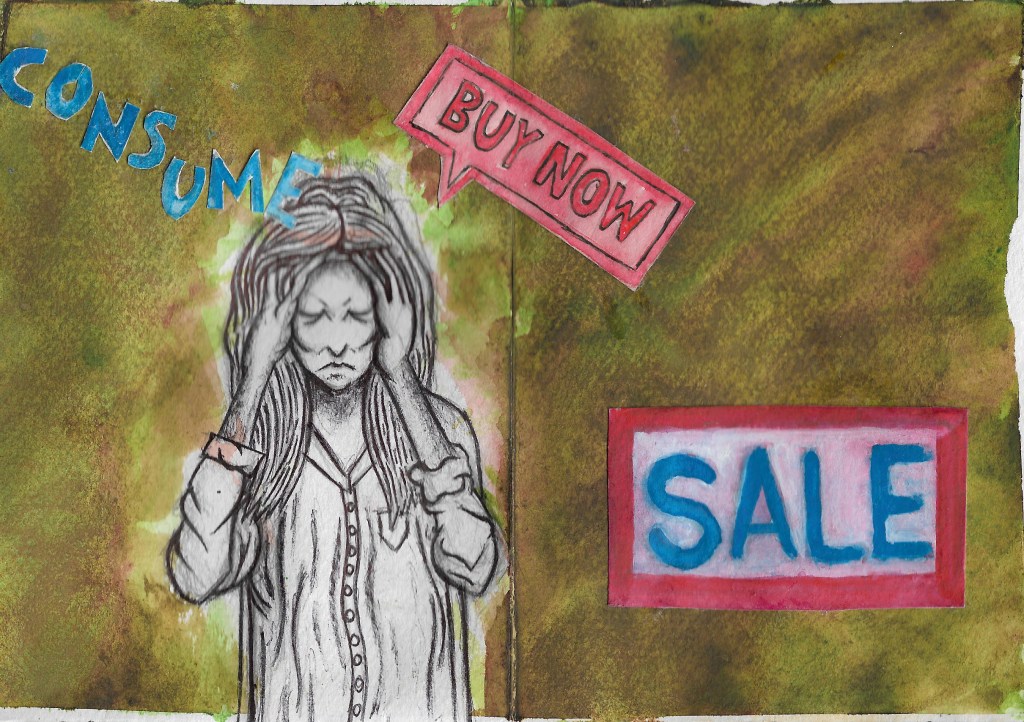
I have currently come up with 3 main ideas for the zine and made sketches to illustrate them. The drawings are really ropey, but they are just initial sketches and will improve dramatically over time. My first idea depicts a woman who is constantly being bombarded by advertisements that tell her to buy things, the constant pressure has driven her into serious anxiety. I came up with this idea because the Conscious Consumption brief suggested that we explore not just what we consume, but why, and advertisements are certainly a huge part of why we buy so much. They are everywhere, at home on your tv, in magazines, newspapers, online. They don’t stop inside either, almost everywhere you go outside, especially in more urban areas, there are advertisements on huge billboards, on buses and at bus stops, even on the side of bridges. Always telling you to buy something new and this can put a lot of pressure on people to buy more stuff. It has also created a culture where you can be considered uncool if you don’t own the latest thing, latest fashion trend or technological item. People can bully you for it and that adds to the pressure to consume even more. I really want to show this from a focused and personal point of view by depicting what the pressure can do one single person.

Plastic Orca Initial Sketch

With my second idea I am aiming to show where the plastic people discard ends up, in the stomachs of marine animals. While it may not be clear with my initial sketch, this illustration will depict an orca made up entirely of ocean plastic, symbolising how plastic is consuming the ocean and everything within it. This is my favourite idea out of the three I currently have, as it tries to raise awareness to an issue I care greatly about, animal conservation. I want to show people that their actions have consequences that affect innocent creatures that have no way of fighting back against the things we do. The idea will be largely visually inspired by the work of Good Wives and Warriors who often create highly complicated illustrations that are made up of smaller illustrations and digitally collage them together.

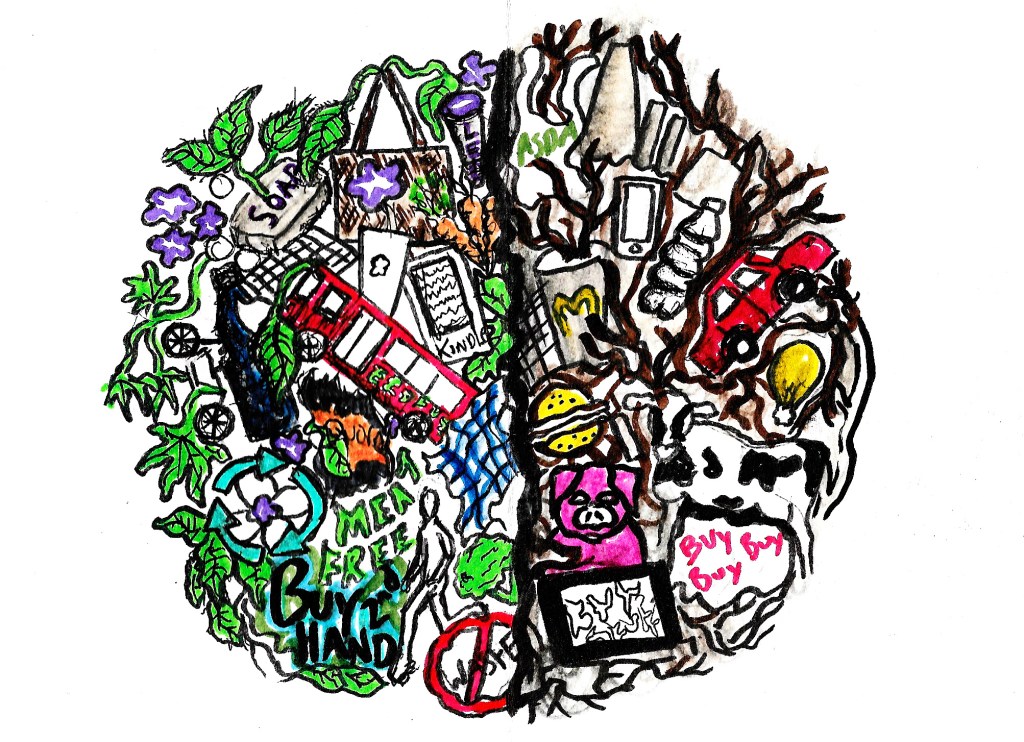
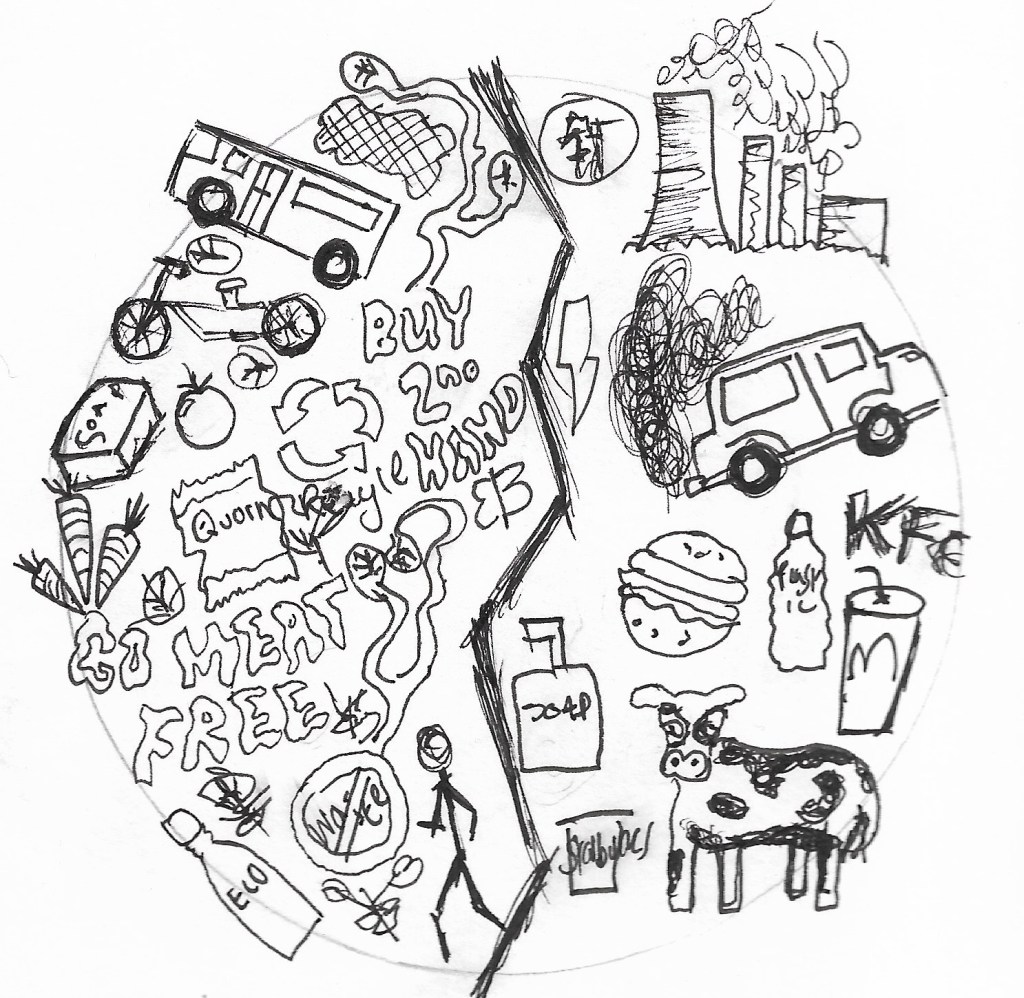
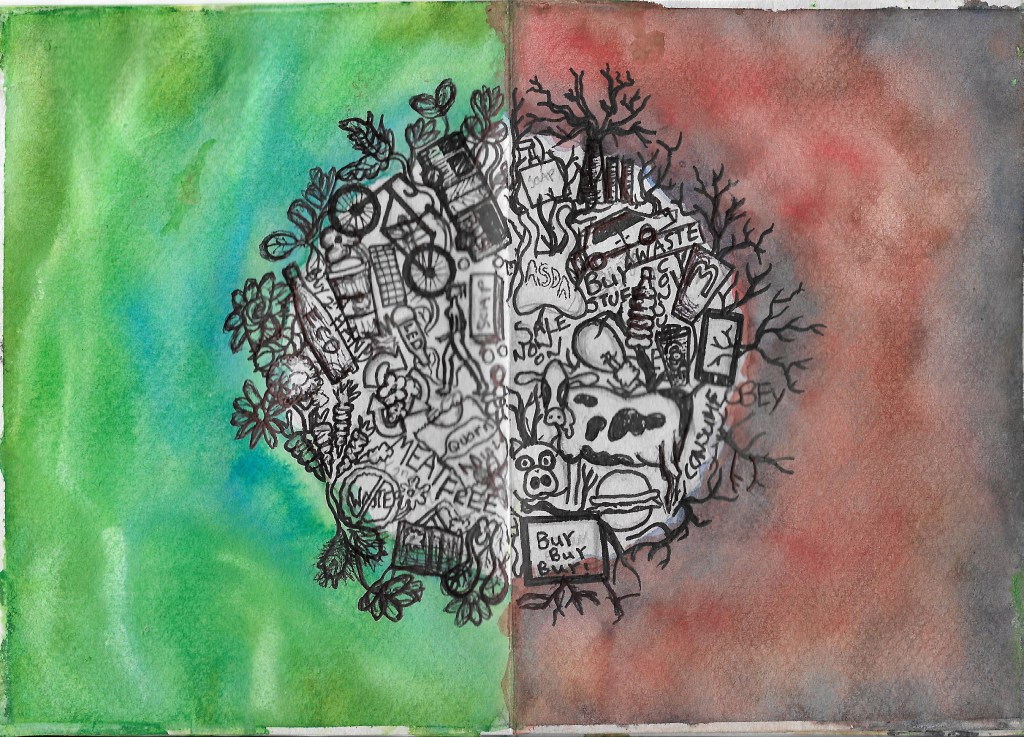
Finally, my third idea takes a less negative approach to showing Conscious Consumption. It would show the planet made up of small consumer products. On one side of the earth there will be products that are harmful for the environment, such as single use plastic water bottles. The other side of the earth will be made up of eco-friendly alternatives to harmful products, such as reusable steel water bottles which don’t end up in the ocean. The aim of this illustration would be to educate people on sustainable buying by showing them that there are less harmful ways to consume without making any big changes to their lives. Small changes, big impact.

Normally I would choose one of the ideas to develop and take forward, however, since I am creating a zine which is going to require multiple illustrations, I am most likely going to develop all three of them. I may even come up with more ideas as I go along. My next step is creating development drawings from these initial sketches and also researching ways I could make a zine. Currently I am thinking of using the one page zine method as it is the only one I am familiar with, I haven’t really created a zine before so I am going to need to research a lot.

Illustration Changes alot, What is Trending Now?

Flat colour, clean vectors and a limited colour palette have been dominating the illustration scene throughout the 2010s, largely because of the rise in digital painting programs such as Photoshop. These designs take a ‘less is more’ approach that can add an air of sophistication to an illustration.  A reduced colour palette also makes the illustrator think about the colours they are using.

A counter trend to the simplistic and colourful flat vector art is the resurgence of printmaking and traditional looking illustrations that has been occurring lately, much to my joy. Traditional looking illustrations add a uniqueness that seems to be missing from the flat, simplistic digital illustrations that dominated in the 2010s, many companies are turning to a more traditional looking approach that adds a certain warmth to the illustration and helps them to stand out from the crowd.

Another thing that has seen a rise in popularity recently is pieces that blur the lines between illustration and animation. As our attention spans get shorter and shorter, illustrators are having to find new ways to keep audiences engaged with their work. Things such as gifs, images that move are making the lines between animation and illustration even greyer.

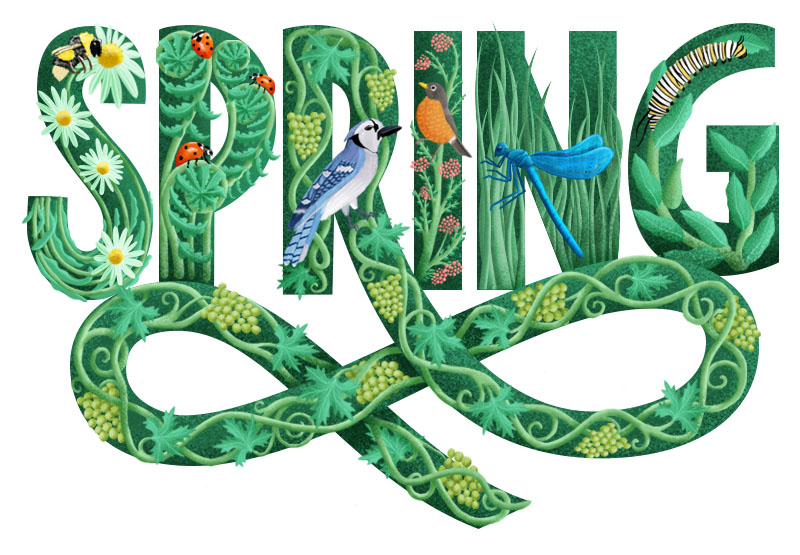
Illustrated letters and typography are a trend that has been around for a while and is here to stay. While typefaces still have their uses, they just can’t blend an illustrative style into an image the same way that typography can. Illustrated letters make a blog of text stand out and add character to a page, illuminating the worlds that follow them.

(Maywst, 2016)

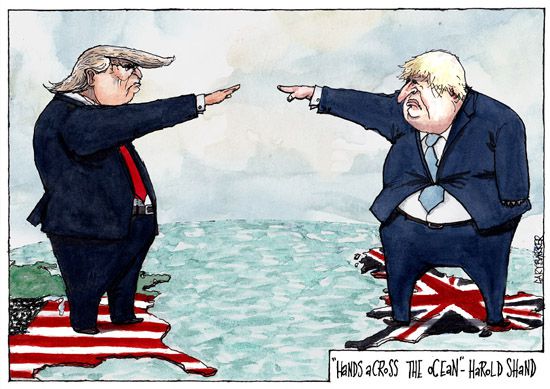
While political statements might not be a trend for everyone, they still do play a huge part in illustration today. With all of the crazy things going on in the world right now, from Brexit to the re-elections in the US and everything else, many people are turning to illustration to express their views and deal with the current world crisis in their own way, be it through satirical art or otherwise, I expect that this trend is just going to grow even more throughout the course of 2020.

(Barker, n.d.)

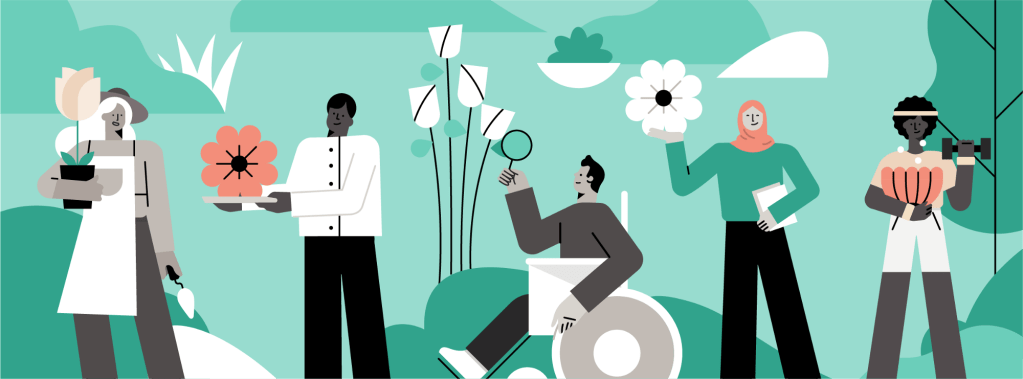
In the 2010s we finally started moving away from deplorable ‘body shaming’ and instead headed towards celebrating our personal and physical appearance. Many illustrators have been captured all of the different ways our bodies are perceived in imperfect and wacky ways. They have done this through wobbly lines, uneven brush strokes and odd proportions. An add on to this is the surge in inclusive art that has been becoming more prominent in the past year, people from all ages, backgrounds and lifestyles are coming forward in a multitude of visual styles. Illustration itself is becoming as in demand, if not more as photography within editorial illustration, so the demand for inclusive illustration is just going to get larger and hopefully it will be a trend that is here to stay.

(Byrd, 2019)

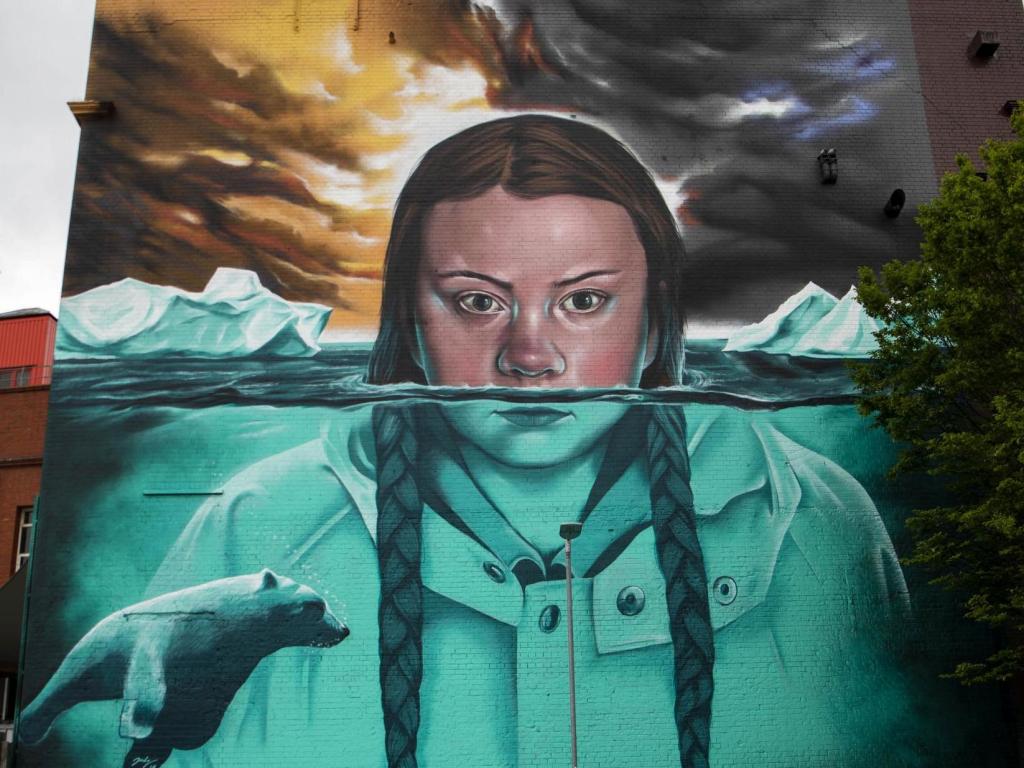
With the rise of figures such as Greta Thunberg and David Attenborough who are fighting for our planet and making it mainstream, and also the increasing availability of eco-friendly products and meat alternatives, sustainable living is itself becoming a huge trend. This is translating into the illustration world too; more and more illustrators are tackling issues such as climate change and over consumption and urging us to live a more sustainable life and to do our part to save our home and the animals that live on it. This is a trend that I hope never goes away, and one that I too am a part of.

(Thomas, 2019)

Maywst, R., 2016. Illustrative Lettering Process — Ray Mawst Lettering & Design. [online] Ray Mawst Lettering & Design. Available at: <http://www.raymawst.com/blog/2016/3/11/fosz1e117f33nrg3fvuqldwzzk1jmt&gt; [Accessed 28 March 2020].

Barker, G., n.d. Trump Cartoon Boris. [online] UK Political Cartoonist Cartoons. Available at: <https://www.garybarker.co.uk/donald-trump-boris-cartoon.html&gt; [Accessed 27 March 2020].

Byrd, T., 2019. Illustrating A More Inclusive Brand. [online] Medium. Available at: <https://medium.com/facebook-design-business-tools/illustrating-a-more-inclusive-brand-bbb4fa6c4bb3&gt; [Accessed 28 March 2020].

Moran, L., 2019. Huffpost Is Now A Part Of Verizon Media. [online] Huffingtonpost.co.uk. Available at: <https://www.huffingtonpost.co.uk/entry/greta-thunberg-street-art-jody-thomas-bristol-upfest_n_5cdeb690e4b00735a915598e?ri18n=true&gt; [Accessed 28 March 2020].

May, T., 2019. 10 Top Illustration Trends For 2020. [online] Creative Bloq. Available at: <https://www.creativebloq.com/features/illustration-trends-2020&gt; [Accessed 28 March 2020].

Lee, E., 2018. Trends From The London Illustration Fair 2019 | Printed.Com Blog. [online] Printed.com Blog. Available at: <https://www.printed.com/blog/trends-london-illustration-fair-2019/&gt; [Accessed 28 March 2020].

Digital Arts. 2020. 2020’S Best Up-And-Coming Illustrators. [online] Available at: <https://www.digitalartsonline.co.uk/features/illustration/illustrators-wholl-kick-off-2020s-in-style/&gt; [Accessed 28 March 2020].

What is New Scientist Magazine and Why Should You Read It?

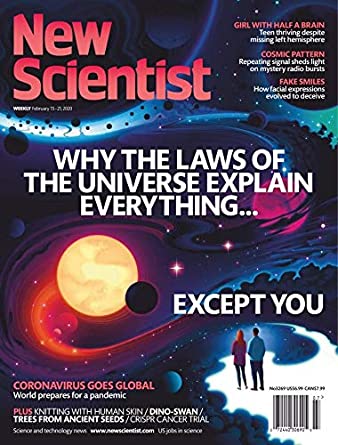
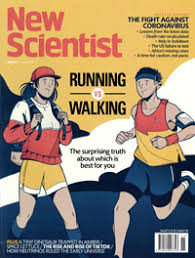
New Scientist magazine is one of the world’s most popular weekly science and technology magazines. Their magazine is featured online, through print and also on app editions which means that the illustrations and layout present in the mag need to be formattable across these areas. The magazine covers stories about science and technology that intrigue, inform and entertain the widest possible audience, which consists of people from a wide variety of lifestyle, from physicists, biologists to people that have no background in science at all. They have an unrivalled global reach largely in part to the fact they have been around since 1956 and have offices working for them around the world.

New Scientist does it’s best to stand out from the crowd, from writing exclusive scientific stories from an angle that can’t be found anywhere else, to hiring independent illustrators to design their covers and colourful illustrations that are carefully placed throughout each issue of the magazine. New Scientist really is one of a kind. They do something that a lot of science magazines don’t, they explore the social and cultural impacts of both scientific and technological discovery, as well as any consequences they could pose on society, rather than just documenting them. As well as exploring the social and cultural impacts of discoveries, they also write regular features and commentary on environmental issues, something that I am highly passionate about. This is one of the main reasons that I would like to create illustrations for New Scientist one day, they have ethics and aren’t afraid to show it, which is something that I really admire them for.

New Scientist uses often colourful and vibrant illustrations to help explain complex scientific theories and ideas in a more understandable and sometimes conceptual way. This is really important because a lot of their audience don’t have a huge scientific knowledge, but still want to keep up to date with the latest scientific and technological progress, the illustrations within the mag help non-scientists engage with the articles and keeps them coming back for more. They also need to be accurate enough to engage with the audience that are scientists, this must be a difficult line to walk but New Scientist manages to do it regardless. The art editor at New Scientist is Craig Mackie and he says that of 36 illustrated covers that he commissioned in 2015, 17 of them were done by new illustrators. He likes to keep the magazine fresh with new talent and while he does have a list of go to illustrators that he knows he can rely on; he likes bringing in new people that are going to bring something different to the magazine. Working like this is beneficial for both Mackie and the illustrators that he brings on, they get more exposure and the magazine gets to keep being ahead of the curve and stand out from the crowd.New Scientist. 2020.

About New Scientist Magazine | New Scientist. [online] Available at: <https://www.newscientist.com/about/&gt; [Accessed 26 March 2020].

Carless, J., 2020. What Art Directors Want: Tips For Editorial Illustrators | Create. [online] Create.adobe.com. Available at: <https://create.adobe.com/2016/4/20/what_art_directors_want_a_guide_for_editorial_illustrators.html&gt; [Accessed 26 March 2020].

New Scientist. 2020. Guide For Freelancers | New Scientist. [online] Available at: <https://www.newscientist.com/in209-guide-for-freelancers/&gt; [Accessed 29 March 2020].

https://www.newscientist.com/in16-about-new-scientist-magazine/

Newscientist.com. 2020. Magazine Archive 2020 | New Scientist. [online] Available at: <https://www.newscientist.com/issues/&gt; [Accessed 29 March 2020].

Final Project Week 1

This is my first week working from home because of the coronavirus and I am finding it exceptionally weird and difficult to do so. I have never been good at doing my project work at home due to lack of space and usually do the majority of my work in college, so doing my final project is going to be a challenge. Nevertheless, I have started the project in the same way as I would start any other, with mind maps and research.

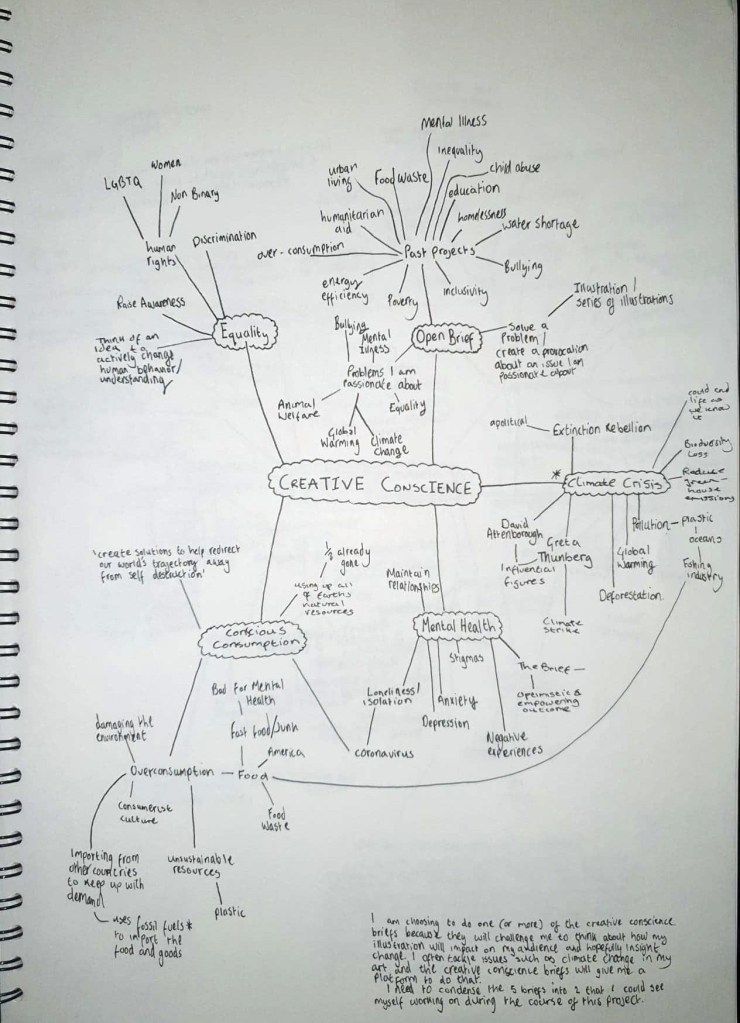
Creative Conscience Mind Map

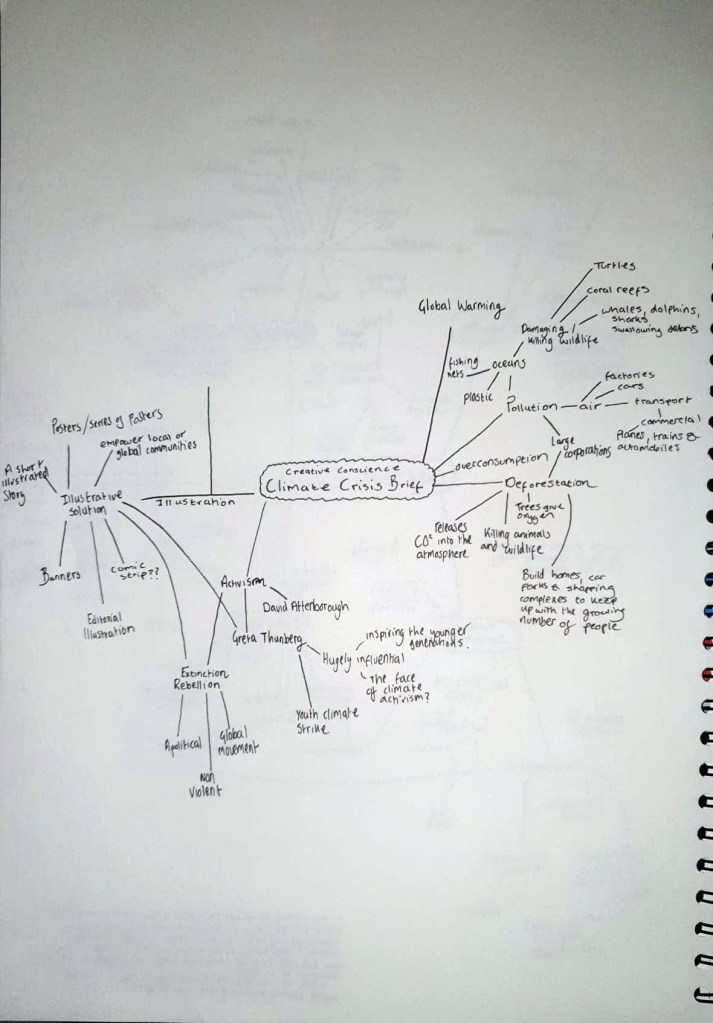
I laid out in my proposal and treatment that I aimed to create a zine for the Creative Conscience Conscious Consumption brief, but I was also leaning towards the Climate Crisis brief so I created mind maps for each of them. The more I looked into the Climate Crisis brief, the more I realised it was too ‘in your face’ as it is endorsed by Extinction Rebellion. I agree with their values, but I do not agree with their methods which often negatively affect everyday people who are just trying to get on with their day, such as when they stopped tubes in London from running. My wariness of Extinction Rebellion is why I only created a small mind-map for this brief. Once I have finished the zine for the first brief, I intend to create a standalone illustration for the Creative Conscience Mental Health brief during the last 2 weeks of the term. This will be a mini project and won’t require as much in depth research and development, which is good because as well as doing college work, I also need to continue creating illustrations for my aunt’s book. I am undoubtedly going to be very busy over the next couple of months, which hopefully means that I won’t have time to be down about the whole coronavirus lockdown thing.

I researched editorial illustration because it is the career path that I am most likely to go down, this is also why I have chosen to create a zine for this project, as it is a form of editorial work. New Scientist is a publication that I would like to create work for someday so I decided to research them further, I would also like to work for Little White Lies and The Guardian, so I intend to research them more later in the project. As well as looking into companies that I would like to work for. I also researched some artists that wills serve as good inspiration for me during the course of the final project, these were Tim McDonagh and the creative duo Good Wives and Warriors, all of which have illustrated for New Scientist in the past.

Now that my primary research is finished and mind-maps are finished, I need to move onto my initial ideas and sketches to go along with them. I’ll also need to work on media testing so that I can figure out which medium would be best to create the zine. This is going to be my focus for the next week. I am a bit worried that by choosing to create a zine I have bitten off more than I can chew because it is going to involve creating multiple illustrations, as well as text, but it feels like natural progression from the front cover and double paged spread I created for LWL during the last project. There’s a chance that my ideas could change over the next few weeks if I end up realising that I have set myself too much work. I hope this doesn’t happen though because I have wanted to create a zine for quite some time and this project is the perfect opportunity to do so. I am most likely going to make the zine in a digital format because I don’t have access to any substantial printing facilities besides my old office printer, which is okay, but it’s nowhere near good enough to print zines.

Editorial Illustration Research

If there is one thing that the editorial illustration project taught me, it is that I could see myself going down that route as a career path, at least to help me fund my own personal projects. There has been a growing demand for illustration for publications over the recent years and it’s easy to see why, in an age where anyone can create content from the comfort of their homes, it has become increasingly difficult for publications to stand out from the crowd, which is why some publications, such as Little White Lies, New Scientist and Weapons of Reason and newspapers such as the Guardian are hiring independent illustrators to create stunning visuals that remove them from the sea of overused press shots, oversimplified vectors and overtly technical fodder.

I have done some further research into this area ahead of my final project as I see my future progression in the field. Art directors rely on illustrators to create beautiful and eye-catching illustrations that help to express complex ideas, articles and theories in a more accessible and understandable way for us normal folk to digest. Working together with illustrators, art directors try to create the best possible way to visually tell a particular story or illuminate an idea. As well as making complex ideas more accessible, editorial illustrations also bring stories to life and engage readers in a way that text alone can’t achieve. Illustrations help to break up a block of text and capture the essence of what is being said in an article.

(Heath, 2017)

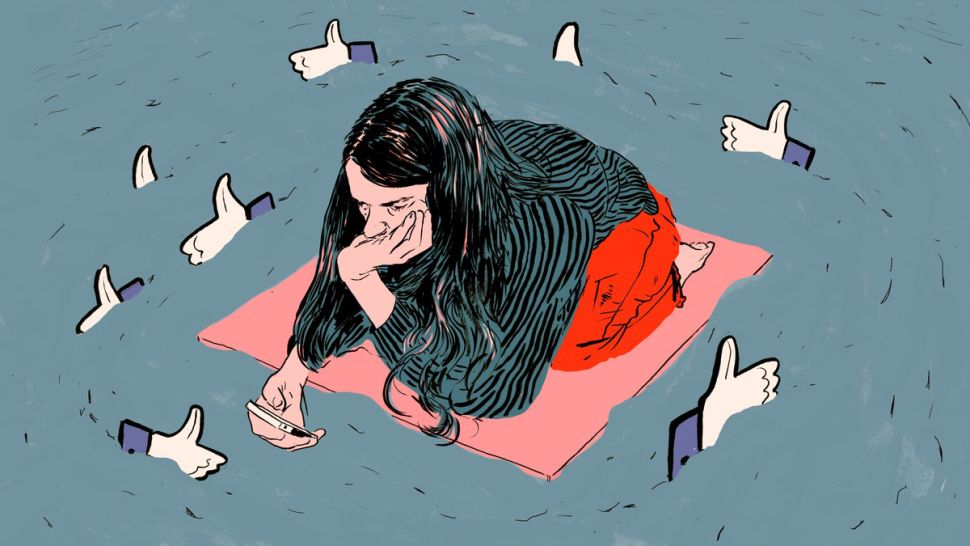
There are many different magazines and newspapers out there, almost all of which require a different illustrative style so there is a place for just about every style within the industry and publications are often playing with different aesthetics to keep their publication fresh. I find this reassuring because I haven’t yet figured out a specific style for myself, I can work in quite a few so it’s nice to know that I’ll be able to find some editorial work regardless of whether I have a ‘house style’ or not. Some complex stories will require a more expressive illustration, such as an illustration created by Calum Heath for Vice that depicts an isolated girl surrounded by Likes which encircle her like sharks which was shown alongside an article about cyber-bullying. This illustration perfectly captures the dangers of social media, especially to someone who is alone and vulnerable, there are a lot of horrible people online that say awful things to people while hidden behind a screen. There’s also the constant need to get likes online which can have a negative impact on one’s mental health.

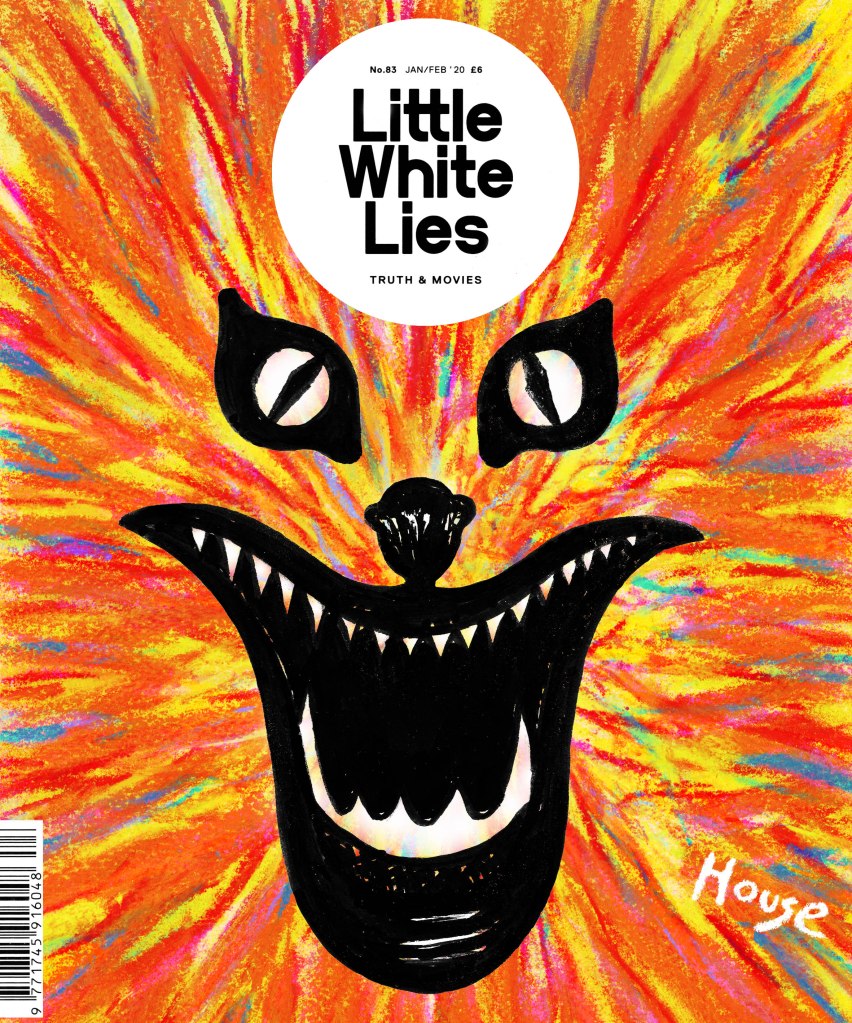
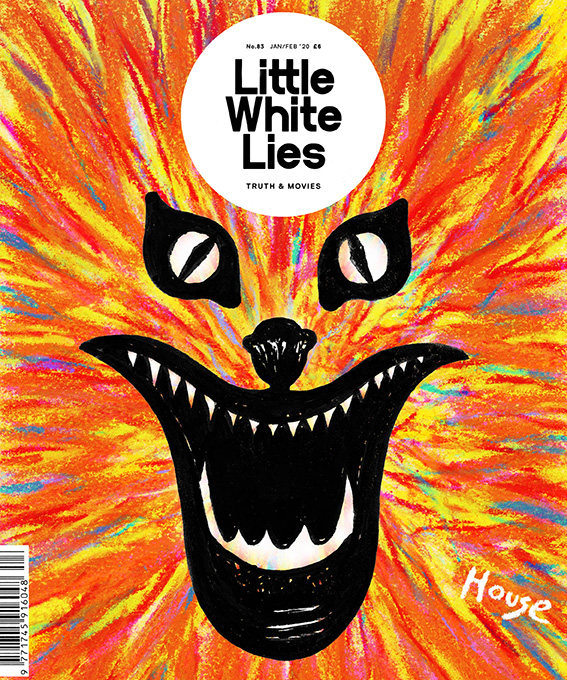
Cyber-bullying is just one of the many complex issues we are facing in 2020, things such as politics, the environment and climate change, women’s and LGBTQ issues and immigration are all problems we’re facing today. There is a huge need for illustrators to come up with engaging ideas on how to express these concepts in such a way that really gets to the heart of the problem and urges the viewer to be a part of the solution. This is part of why I think that editorial illustration would be a good path for me to go down because I do often tackle such issues in my art, and had hopes of creating a graphic novel that tackled climate change but it would be exceptionally hard to get funding for such a thing. The graphic novel idea is perhaps more personal than commercial. Going into editorial illustration would allow me to tackle the issues that I am passionate about, try and make the world a better place and also make a living in a more commercially viable area of illustration, there is a huge need for editorial illustrators right now and I could use the money I make to fund my own personal projects in the future. I have already proven that I have potential with editorial illustration based on my previous project where I created a front cover design for Little White Lies based on the 1977 movie house, the design recently got liked on Instagram by LWL themselves and they commented that they love it. This really made me happy and gave me hope. I am going to research into how to become an editorial illustrator and also research further into publications and companies that work in the field to continue the research for my final project.

Little White Lies House Design

References-

Ewens, H., 2017. The Brand New Face Of Cyberbullying. [online] Vice. Available at: <https://www.vice.com/en_uk/article/gyy8kq/the-harsh-new-world-of-teen-cyberbullying&gt;

Carson, N., 2018. 8 Inspiring Uses Of Editorial Illustration. [online] Creative Bloq. Available at: <https://www.creativebloq.com/inspiration/8-inspiring-uses-of-editorial-illustration&gt;

Wang, G., 2018. 12 Independent Magazines With Clever, Imaginative Illustration – STACK Magazines. [online] STACK magazines. Available at: <https://www.stackmagazines.com/illustration/12-independent-magazines-with-clever-imaginative-illustration/&gt;

Carless, J., 2020. What Art Directors Want: Tips For Editorial Illustrators | Create. [online] Create.adobe.com. Available at: <https://create.adobe.com/2016/4/20/what_art_directors_want_a_guide_for_editorial_illustrators.html&gt; [Accessed 22 March 2020].

Hi Fructose Volume 54 Review

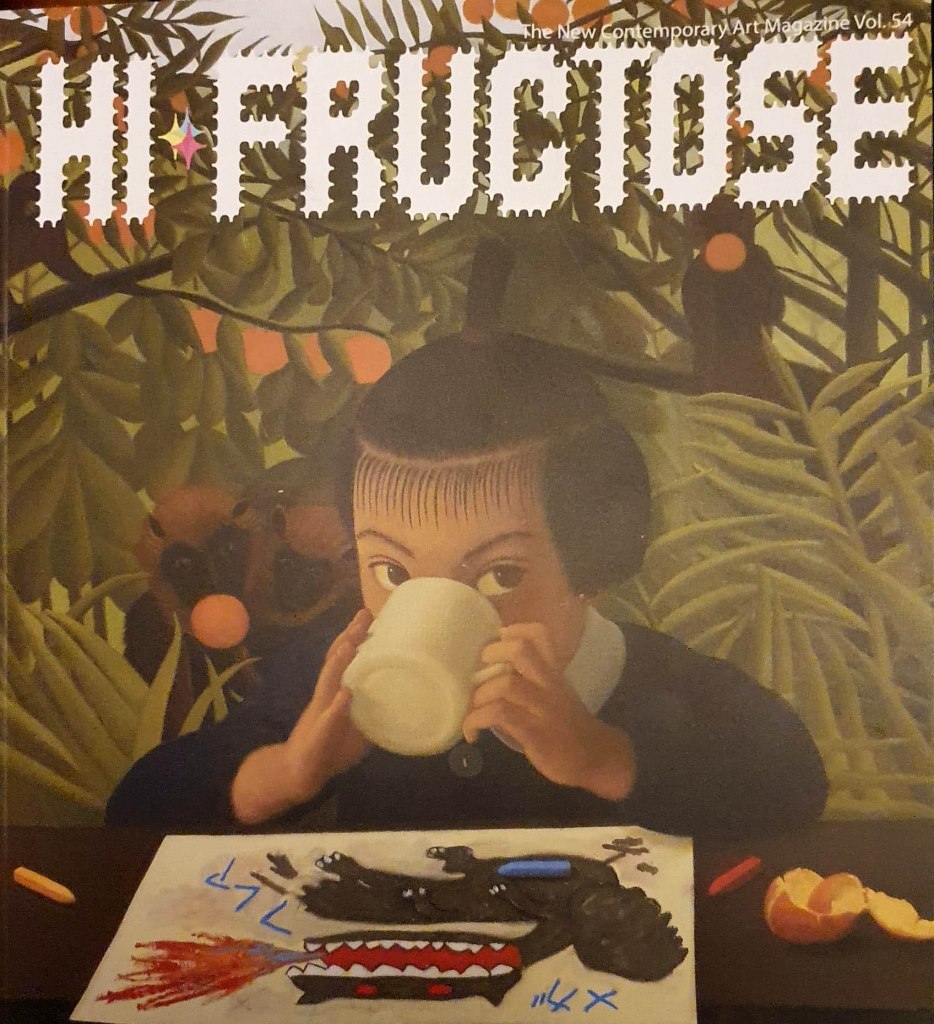
Hi-Fructose Volume 54 Cover- Image taken by Rohan Hall

In this post I will be reviewing Volume 54 of Hi-Fructose Magazine. Now this is the first time I have ever owned Hi-Fructose so I wasn’t too sure what to expect, but I liked the look of their website which is what lead me to purchasing it. The front cover also drew me to this particular issue a bit when I was browsing around in WH-Smith, it seemed to be rather nature focused, with an image of a young girl having a relaxing cup of tea in the middle of a forest/jungle. Gibbons surround the girl in the trees while they tuck into some oranges and stare curiously at the girl who appears to be drawing a picture of a dragon. There is just so much going on in this front cover, the more I stare at it, the more of a story I see and the more questions I have about what is going on. I was definitely drawn to the nature aspect of the cover, it seemed really interesting and I hoped that the nature theme would continue throughout the magazine, and I some ways it did.

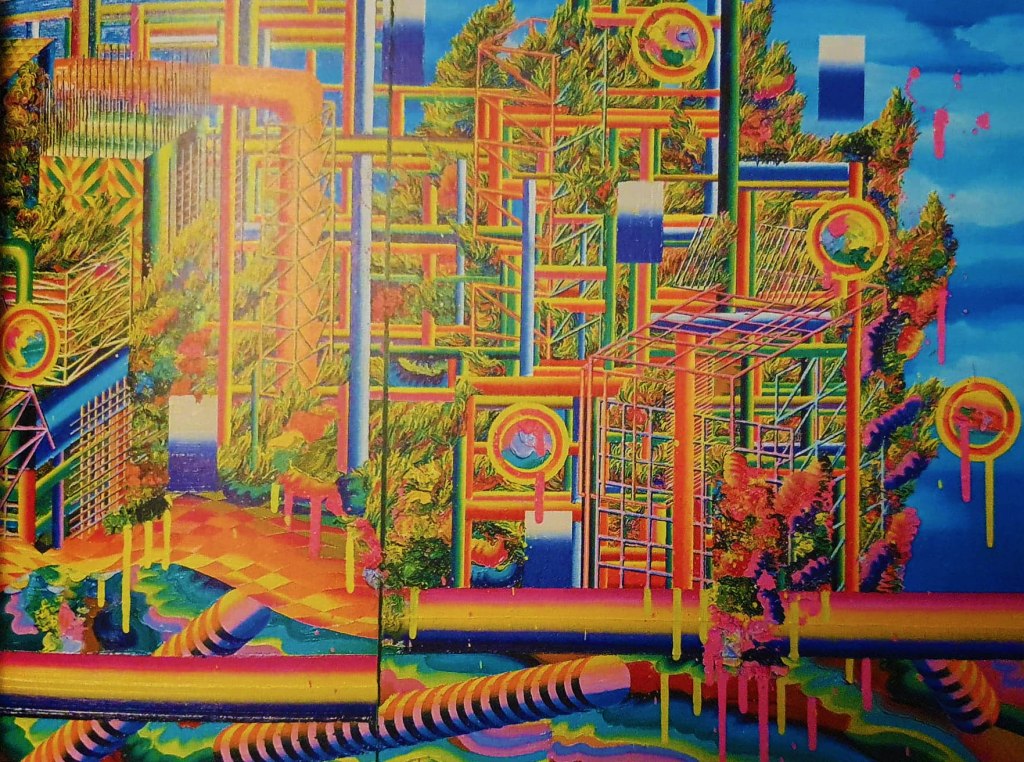
Now I cannot say that I like all of the art that is presented in this magazine, but even the artists that I do not likely still teach me something because the articles in Hi-Fructose are so well written and the interviews go so in depth to each illustrators and artists process to find out why they do what they do. This can be said about the first artist that is featured in this volume of Hi-Fructose, Eunjeon Choi, who creates unbelievably vibrant and psychedelic pieces that are inspired by bonsai trees and the way that they are structured and forced to grow a certain way against their will. To me, Choi’s work is too much to look at, their work feels crowded and overtly colourful and chaotic. This is kind of the point as Choi also takes inspiration from our fascination with artificiality and they chaotic world we have created online and while I do like the idea behind Choi’s work and their motivations, the art itself is just too much for me.

Eunjeon Choi artwork featured in HI-Fructose Volume 54- Image taken by Rohan Hall

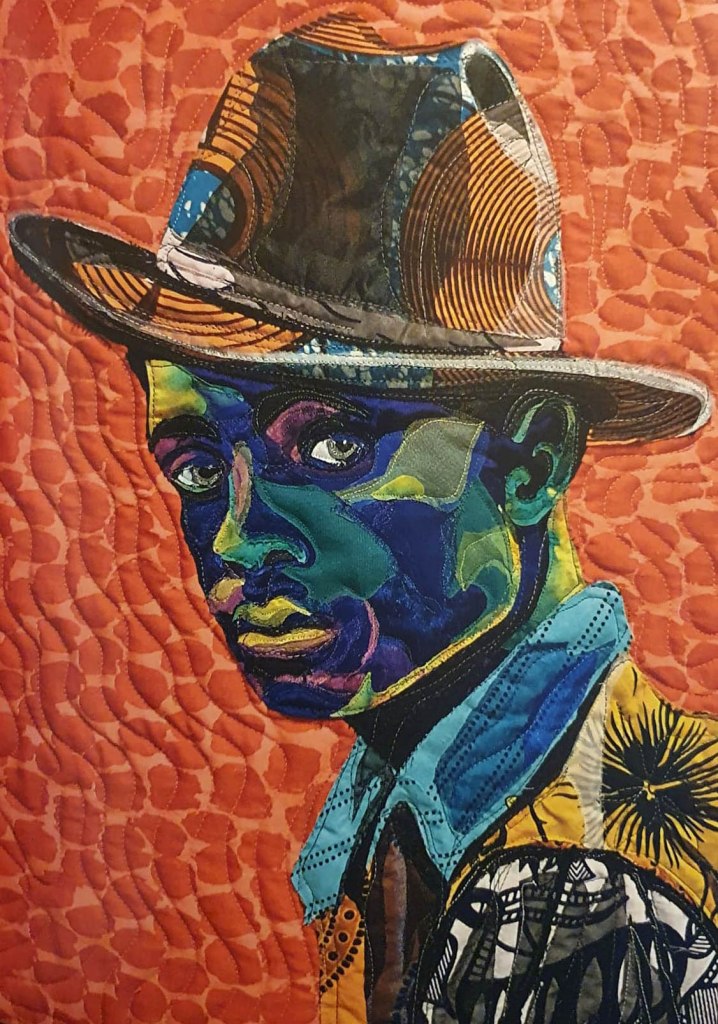
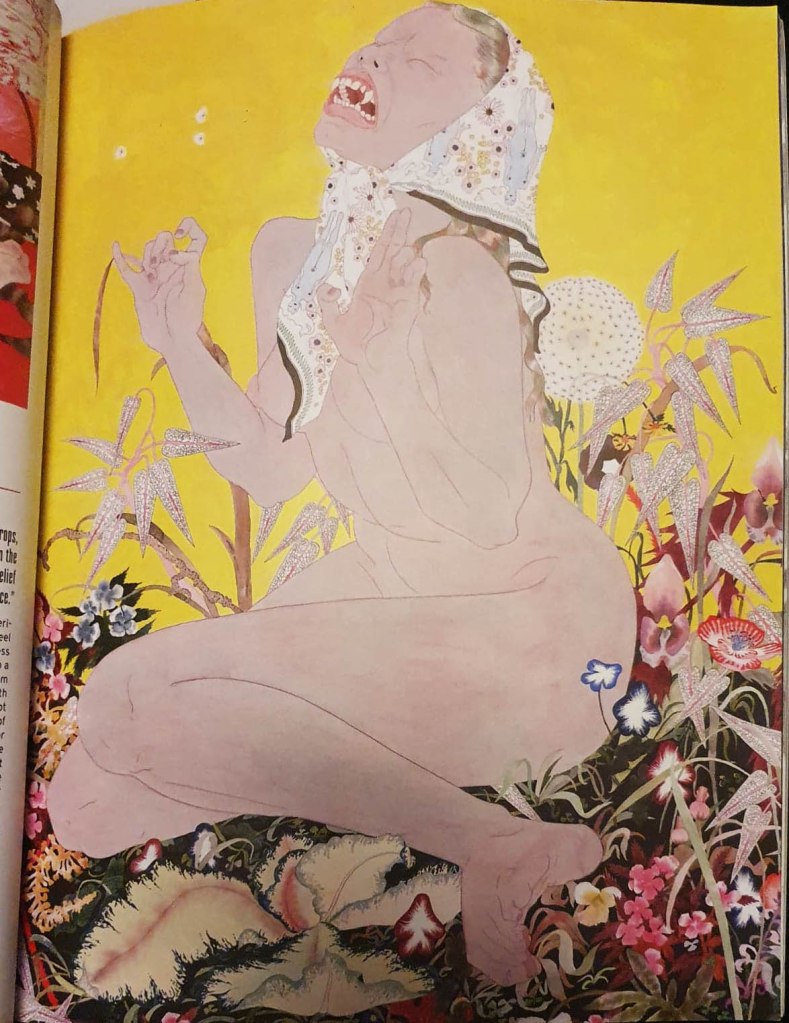
There are artists in this issue of Hi Fructose that really inspire me, artists such as Rikka Sormunnen and Bisa Butler who use their respective mediums to try and fight for change in the world and raise awareness to current issues that unfortunately are on the rise in 2020. Riikka Sormunen subverts the impossible beauty standards placed on women by men by using traditional poses that are often associated with beauty and turns them into something uncanny, something slightly disturbing. She has plans to start drawing women with stretch marks and cellulite in the future. Bisa Butler uses fabrics to create stunning, actual size portraits of unnamed African Americans in an attempt to give them the respect they never received in life. Her portraits are also made to confront people who do not believe that African Americans are equal, to challenge their misled preconceptions and force them to look them in the eye and question why their negative views.

There are a lot more artists featured in this issue of Hi-Fructose, there is even a small book contained within which is a nice extra bonus. Each page is beautifully laid out and has opened my eyes to a whole host of illustrators and artists that I didn’t know about before. I am definitely going to be buying more issues Hi-Fructose in the future. The magazine seems to be catered to young adult/adult audience, since quite a few of the artists draw mature things and the topics that are presented within the magazine are quite complex, as is the way the interviews and articles are written. I just don’t think a child would be able to understand much of what is going on within Hi-Fructose.

This magazine is going to help me a lot in my college work, it will provide me with a wider range of artists to research and explore which id dint have before. I also intend to use it as a part of my research for the essay which we have been asked to write before the 19th of March.